
Peasant unrest.
According to the source below, groups such as peasants, samurai and urban workers demonstrated and rebelled about the changes the country was facing.
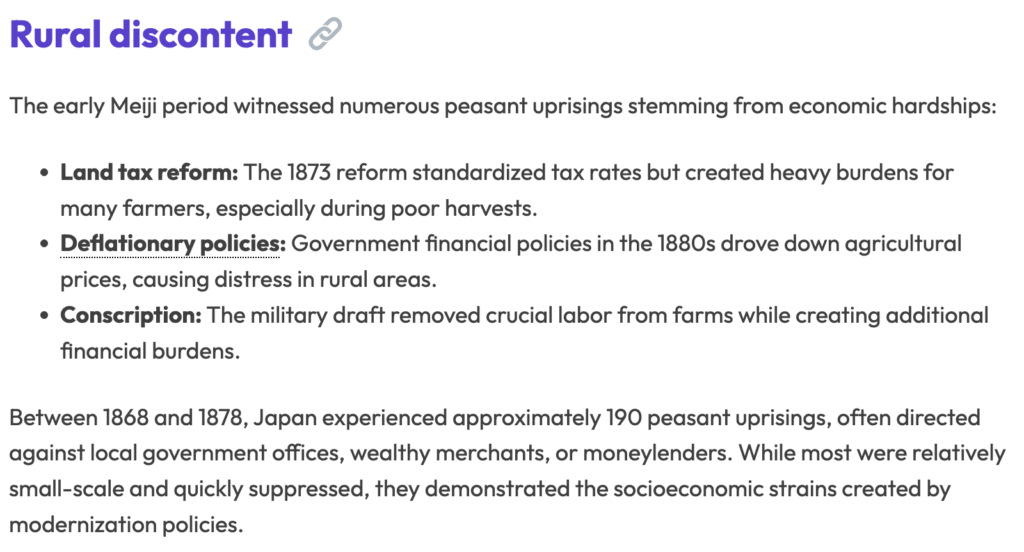
- The Meiji Restoration was focused on creating a government system that was stable and one that developed the country so that it could be powerful enough to deter the West. The focus was therefore not on wealth creation of the masses. Politically, Japan was more of a oligarchy in the 1870s and 1880s, at least until the 1890 Constitution was passed. Consequently, these oligarchs were able to grow their wealth too
Satsuma Rebellion.
This movie was loosely based on the Satsuma Rebellion, particularly the Battle of Shiroyama in 1877.
There are a few historical inaccuracies, the lead character is actually not American nor look like Tom Cruise and the battle was not rifles v swords as the samurai had some modern weapons, but there is some truth behind the storyline. The following is more accurate:
- Why did the Meiji Government abolish the samurai order?
- Why were the samurai, particularly Saigō Takamori, eventually opposed to the decisions of Emperor Meiji’s government even though he had initially been in support of him?
- How was the Meiji Government able to overcome the samurai?
The Boshin War of 1868 to 1869
The Bosin War, essentially a civil war, took place between 1868 and 1869. It culminated in the Shogun renouncing his claim to power. However, some provinces and daimyos rejected the new authority in Japan and fought on until 1689.
- It is important to add that in 1876 the Meiji government abolished samurai stipends and replaced them with bonds. This had several key consequences:
- the government was able to save money.
- the bonds more or less forced the samurai to become capitalists.
- although some were unhappy and this may have contributed to rebellions such as Satsuma.
Foreign Relations and imperialism.
A key point to make about the Meiji Restoration was that prior to it, in 1853, Japan was powerless to reject the US demands. Fast forward to 1904/5 and their fleet was powerful enough to defeat one of the great powers of the world, Russia in the Russo-Japanese War.
- Why did Japan and China agree a trade treaty in 1871 and what was agreed? 0:40-1:10
- Which two areas of land caused flashpoints between the two nations? 1:10-1:52
- How did the issue of Korea cause war between the two? 2:38-4:08
- Why did Japan win the first Sino-Japanese War of 1894-95? 4:08-5:10
According to Reischauer:
- Japan was aiming to emulate the great empires of France and England by possessing a powerful military. This may give them respect and equality with the West.
- However, the view that Japan was a traditionally imperialistic nation is not accurate. It had signed treaties with both Russia and Korea in 1875 and 1876 respectively. They even agreed with China to withdraw their military forces from Korea to keep relations peaceful…though in 1894 a religious rebellion led to both armies bringing them back and war beginning soon afterwards.
- The West was stunned at Japan’s victory against China in 1895. The Treaty of Shimonoseki gave Japan the country Taiwan, Korea, the Liaotung Peninsula and a huge indemnity (worth about $18 billion in 2026 money).
- Interestingly, the Japanese government were facing both political and economic domestic problems in the 1890s but it survived both partly through the nationalism the Sino-Japanese War brought to the country.
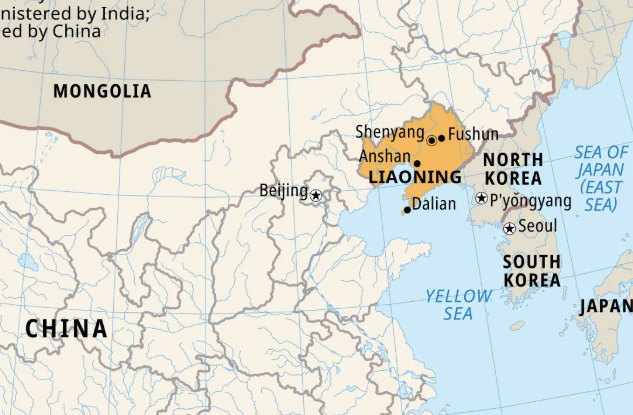
- Although the West largely applauded this act of imperialism, some did not see Japan as equals…France, Germany and Russia forced Japan to give back the Liaotung Peninsula to Russia.
- Two consequences of this were: that Japan saw Russia as a threat and they wanted a Western ally, determined not wishing to face a coalition of European countries such as this again. By 1902, they had found this partner – Britain. The first entirely equal military pact between a Western and non-Western nation was the 1902 Anglo-Japanese Alliance.
- In addition, the constitutional government induced the British to agree in 1894 to give up their extraterritorial privileges by 1889 and other Powers quickly followed suit. The removal of unequal Treaties was accomplished by 1911, perhaps without the change to the constitution none of this would have happened.