
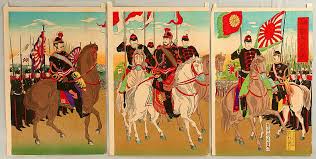
You will study the time period 1853 to 1894, two extremely important years in the modern history of Japan. The country moved from an authoritarian state to something that resembled a constitutional monarchy, and possibly a limited democracy.
In this Focus Study, you will answer the following questions:
A. What caused the transition to take place?
B. How was the transition achieved?
C. What challenges did society face after the transition?
The resources on this page give you a basic introduction to the period prior to the Meiji Restoration of 1868.
The Birth of the Tokugawa Shogunate
Timeline
Below are some of the significant dates in and around the timeframe.
1839-42 First Opium War fought between Britain and China. It led to the Treaty of Nanjing, giving Britain Hong Kong and increased the number of treaty ports from one (Canton) to five.
1853-4 US Navy Commodore Perry first met with the Japanese (although Washington gave permission to do so in 1852). He had a substantial force for the meeting, even publicised to the world beforehand (Perry was determined not to be turned away). The Japanese government wanted to turn him away but knew they were outgunned.
1856-1860 Second Opium War. Britain took advantage of the Qing government’s problems with the Taiping Rebellion to further their trade. A protracted war resulted in GB taking Kowloon and gaining more trade advantages.
1859 By this year, all the major powers had access to Japanese markets and to the key ports. Some also had the law of extraterritoriality agreed upon, whereby foreigners could not be tried in Japanese courts, regardless of their crime.
1860 PM Naosuke assassinated because of his policy of compromising with foreigners.
1868 Meiji Restoration. This was a political and social revolution in Japan from 1866 to 1869 that ended the power of the Tokugawa shogunate and returned the Emperor to a central position in Japanese politics and culture. It is named after Mutsuhito, the Meiji Emperor, who served as the figurehead for the movement.
1871-73 Iwakura Mission, government representatives sent to Europe to gather information.
1894-95 War with China. It was fought over the influence for the Korean peninsula, arguably started by the Japanese by fermenting dissent to Chinese influence. China responded but the ensuing Japanese victory was a surprise to all.
The Birth of the Tokugawa Shogunate
The Shogunate
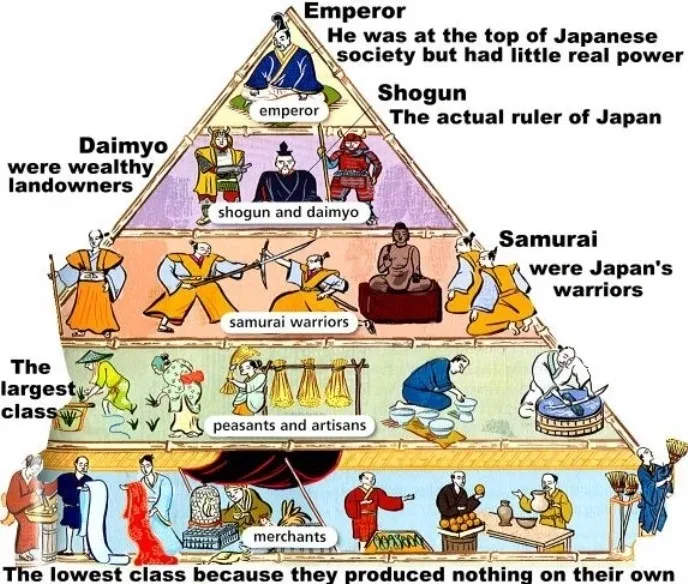
Feudal Japan’s Social Hierarchy: The Shi-Nō-Kō-Shō System
- Kyoto was the emperor’s capital, the Shogun (the military leader) was represented by a governor. However, the emperor was a virtual prisoner in his own palace.
- Edo (later Tokyo) was the Shogun’s capital city. He held feudal control of 15% of Japan’s land and with the samurai (vassals of lords) a further 10%.
- The Bakufu were the administrators of the government.
- The Daimyo were the feudal lords, largely free of Edo’s interference. These lords did not owe anything to the Shogun (such as rice or money) but had to be loyal such was his power to take things away from them. However, they did have to carry out public works when required (perhaps once in a generation).
- The samurai under the Tokugawa Shogunate were largely farmer soldiers. However, this changed and fewer became farmers. Only those samurai in public office or had status were financially secure. To achieve this, nepotism or marriage were required, not merit.
- The Tokugawa hierarchy could be as follows: samurai, farmer, artisan and merchant. However, W.G. Beasley argues in ‘The Rise of Modern Japan‘ there is just samurai and then there is the rest.
- Feudalism prevented the movement of labour, industries were limited in what they could produce, there was largely only the domestic market, and the isolation kept technology back. And as feudal debt was a problem in the 19th century, Japan found it difficult to find solutions.
What was the Meiji Restoration?
According the Kären E. Wigen, what were the key changes from the Meiji Period? 07:04-End