
There are three reasons given by the IB for this question to be answered.
The decline of the Tokugawa Shogunate.
Stagnation and demands for rapid modernisation.
Influence of the US and European countries.
The decline of the Tokugawa Shogunate.
There are arguably two perspectives to this. The first is that it was the Western influence (external) and the second was that it was the internal collapse of the country. We’ll begin with the latter…
The Internal Collapse
The famous economist Adam Smith argued that a ‘stationary state’. In his 1776 book, the Wealth of Nations, he argued that
“In a country too, where, though the rich or the owners of large capitals (money) enjoy a good deal of security, the poor or the owners of small capitals only enjoy scarce, which can be pillaged and plundered at any time… In every different branch, the oppression of the poor must establish the monopoly of the rich, who, by engrossing the whole trade to themselves, will be able to make very large profits.”
Niall Ferguson. The Great Degeneration. Penguin, 2014, p.8
- Smith was referring to China, a country that had once been successful and opulent but because it had remained stationary had ceased to grow. However, had he been alive towards the end of the nineteenth century, he may have included Japan as an example too.
Answer the following questions from the video below:
(clipped from Emperor Meiji & the Meiji Restoration Documentary :
- When and why was japan isolated, and what benefits did it bring the country? 2.40-4.15
- Why do you think the Japanese would have been too difficult to defeat and colonise in the 17th century?4.31-4.48
- Why did this change in the 19th century? What example did the Japanese use to realise this? 4.49-5.27
- What was the impact of Commodore Perry’s visit to Japan? 5.28-6.55
Was the Tokugawa Shogunate ready for change?
As with most historical events, there is no simple answer or agreement on this answer. Taken from Another Look at the Occupation of Japan: Through the Minefields of Japanese History, these excerpts demonstrate this.
Read the two paragraphs below.
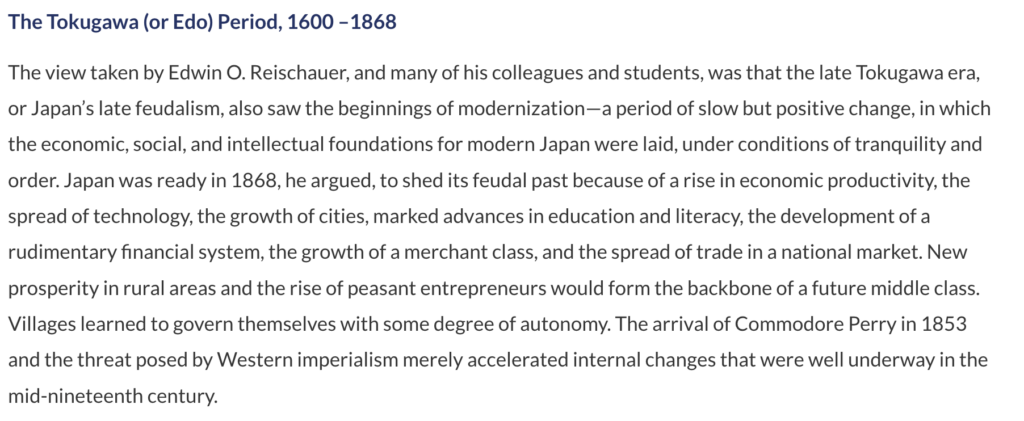
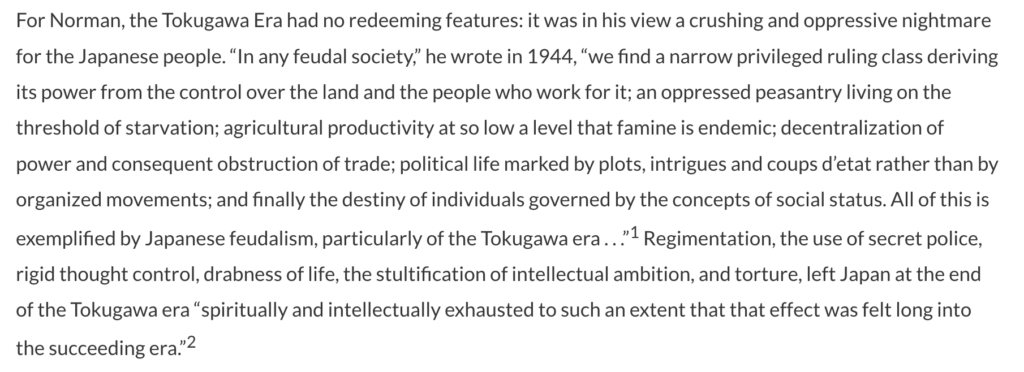
- How do they differ?
Read the following paragraph,
2. Why do you think the two historians have such different interpretations of the Tokugawa Shogunate? It may be useful to research what each have published.
I asked my Gem Bot, Niall Ferguson, the same question and ‘he’ came up with the following:

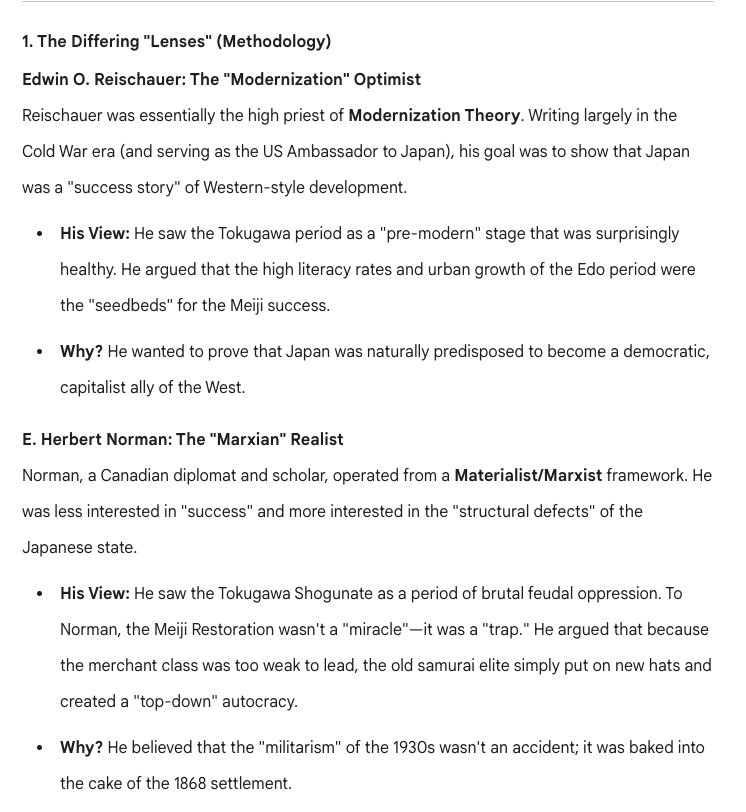
Stagnation and demands for rapid modernisation.
- The 17th century was a period of rapid economic growth, the population growing too. The population had grown sufficiently that economic growth Western style was possible. But feudalism prevented the movement of labour, industries were limited in what they could produce, there was largely only the domestic market, and the isolation kept technology back.
- Agriculture had some developments since the 18th century. This helped create a divide between rich and poor peasants/ farmers. Consequently, there were a series of protests against domain lords and the rise in prices during the 18th century.
- Feudal debt was a problem in the 19th century. The economy may have caused the collapse of the Bakufu (administrators of the government).
- The Bakufu were also contemptuous of merchants, placing them at the bottom of the caste system. The merchant class were growing despite the obstacles placed before them. Therefore, the Tokagawa Shogunate held back the progress of Japan as it limited the capital growth of its merchants consequently, the merchant class fully supported the Restoration).
- Samurai income became the same as some peasants. This was a factor in some becoming ronin and opposing the Bakufu.
- These former samurai had the advantage of having the kuge as allies. These were former aristocrats who focused on Japanese culture such as poetry rather than politics. But their role had declined under the bakufu and they used their influence and knowledge to support the opposition.
- For some of the samurai, their passionate nationalism did not mean a refusal to learn from others. They want to protect Japan and realize they need a stronger defence. Learning from the west was obvious to them. Those, especially Ronin and the lower samurai were the most avid learners of Dutch culture and technology.
- Incorporating foreign ideas such as military science actually maintains the class system with samurai at the top.
- One could argue that the restoration was merely a similar system but we had different samurai in charge.
- In 1842 the Bakufu allowed foreign ships to be refueled fearful of what Britain did to China but this led to the anti foreign party to become opponents of them. These thinkers wanted Western ideas to fire and defend against the West, not to capitulate under foreign.
- The Bakufu wanted absolute obedience to the emperor as this maintained their position. But in reality the emperor had little power, the people behind the Restoration wanted to change this…their slogan of ‘Revere the Emperor, Expel the Barbarians’ was impossible to argue against.
- Shintoism gave the emperor imperial divinity, Confucianism obedience and a code of personal behaviour.
- Japan’s culture changed because of economics, less so politics. There was also a move away from Chinese culture and the establishment of their own.
The Anglo-Japanese hostilities of 1863 – 1864
The Samurai
- You should read the section above to understand how the samurai wanted to overturn the rule of the Bakufu.
- The samurai became largely civil servants and office workers in the 19th century but some were still warriors. They saw their government in Edo ‘capitulate’ to the foreigners.
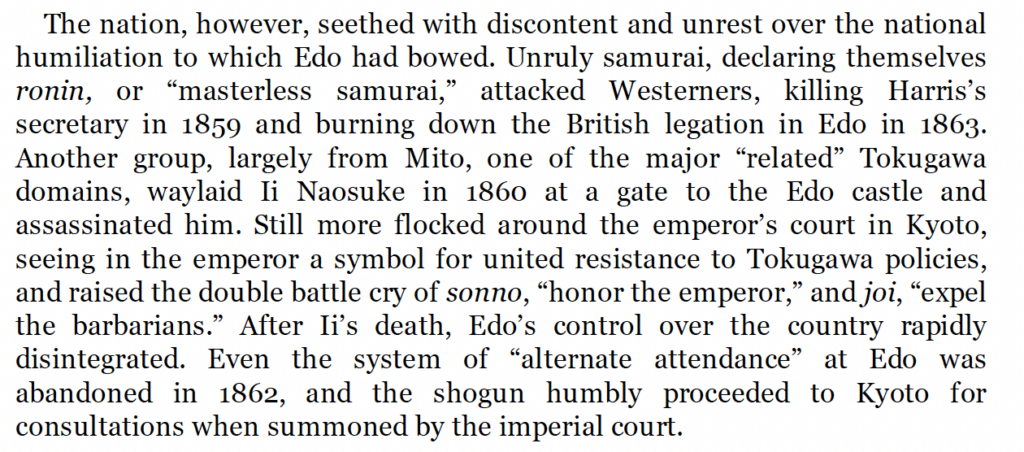
Reischauer, E.O., Japan, the Story of a Nation, 4th edition, New York, Knopf, p.107
A. How can it be argued that the samurai hindered progress in Japan? Secondary Source
B. What does Herbert Norman argue differently?

Norman, H., Japan’s Emergence as a Modern State, 60th Anniversary edition, UBC Press, p.81
Influence of the US and European countries.
Western Influence
What do you learn about Japan from the following source? Secondary Source
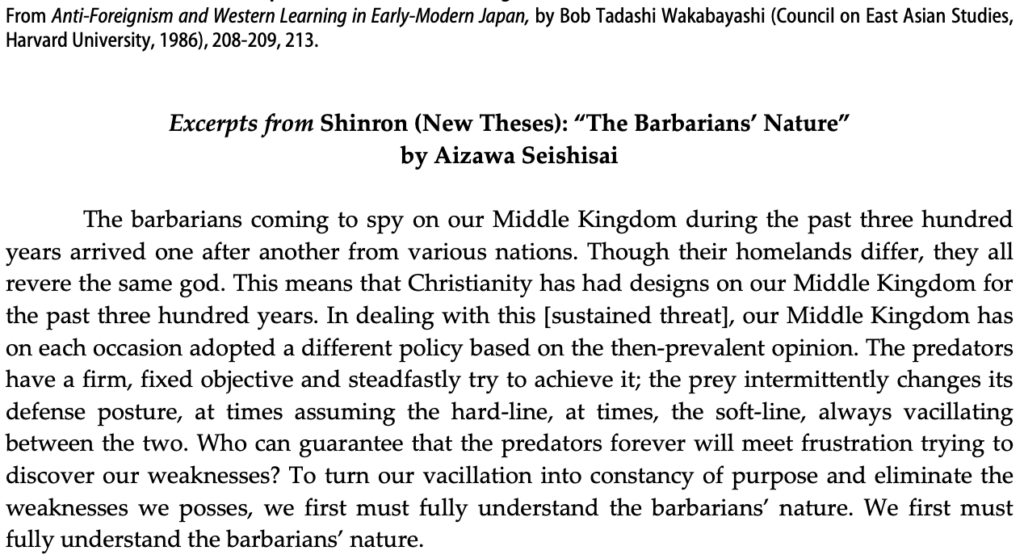
Aizawa Seishisai (1781-1863) was an important Confucian scholar and tutor to the lords of Mito, a branch of the Tokugawa family. Aizawa’s greatest work, Shinron (“New Theses”), was written in 1825.
- In 1853, the USA wanted peace with Japan but as long as she stopped from seeing them as enemies. The letter brought by Perry also contained a plan to bring a larger naval force in 1854, landing in Edo with eight ships. Despite the Bakufu trying to reject Perry, they knew their defences could not repel the Americans and a convention (Treaty of Kanagawa) was signed in which two ports were opened to them.
- Britain, Russia and France were concerned with the Crimean war so the U.S took the opportunity to influence Japan.
What can you infer from this source about US intentions towards Japan? Primary Source
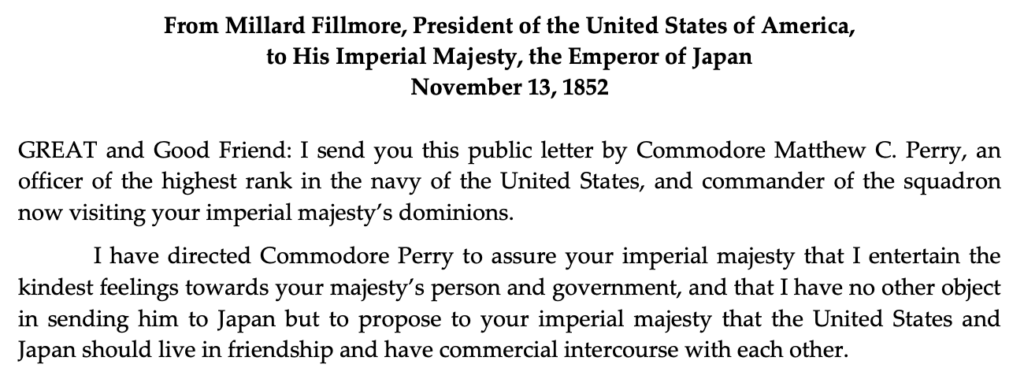
The letter continues with requests for assistance in whale fishing and improved trade links but one of the final paragraphs is as follows.

How is this different to the start of the letter?
What are the values of this letter to the historian?
And what are the limitations?
- Eventually five ports were opened to foreigners: Nagasaki and Kanagawa (Yokohama) from 1859, Niigata from 1860, Hyogo (Kobe) from 1863, and the already open Shimoda and Hakodate. Extraterritoriality (foreigners to be tried under their own law) and low tariffs were part of the deal too. From Edwin O. Reischauer,
Secondary Source
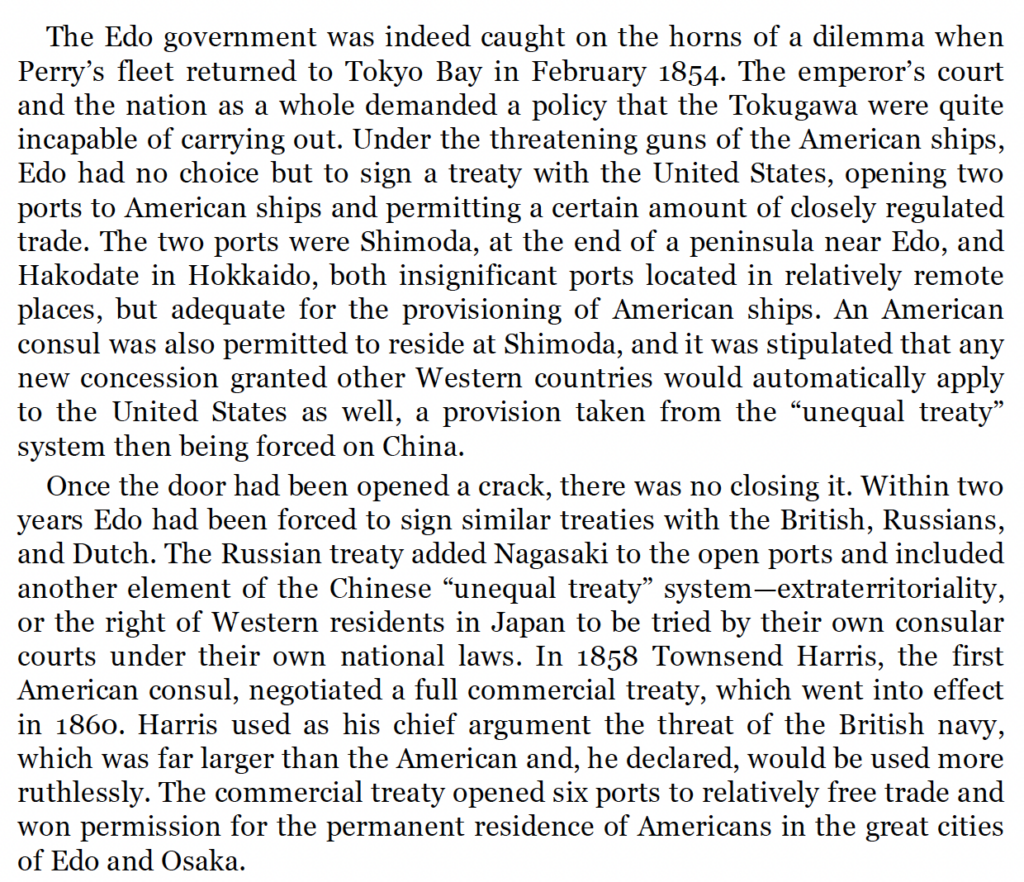
Reischauer, E.O., Japan, the Story of a Nation, 4th edition, New York, Knopf, p.105
- In the Namamugi incident of 1862, a samurai murdered a British man. In response, Britain used gunboat diplomacy to extract concessions and an indemnity. Refusal led to bombardment of the mainland (Satsuma opened fire first). Japan suffered houses and ships destroyed and relented, paying 25 000 sterling in compensation (2.3 million in 2018 money).
- Foreign powers also forcibly opened the Shimonoseki Straits (between islands – see below) in 1864.
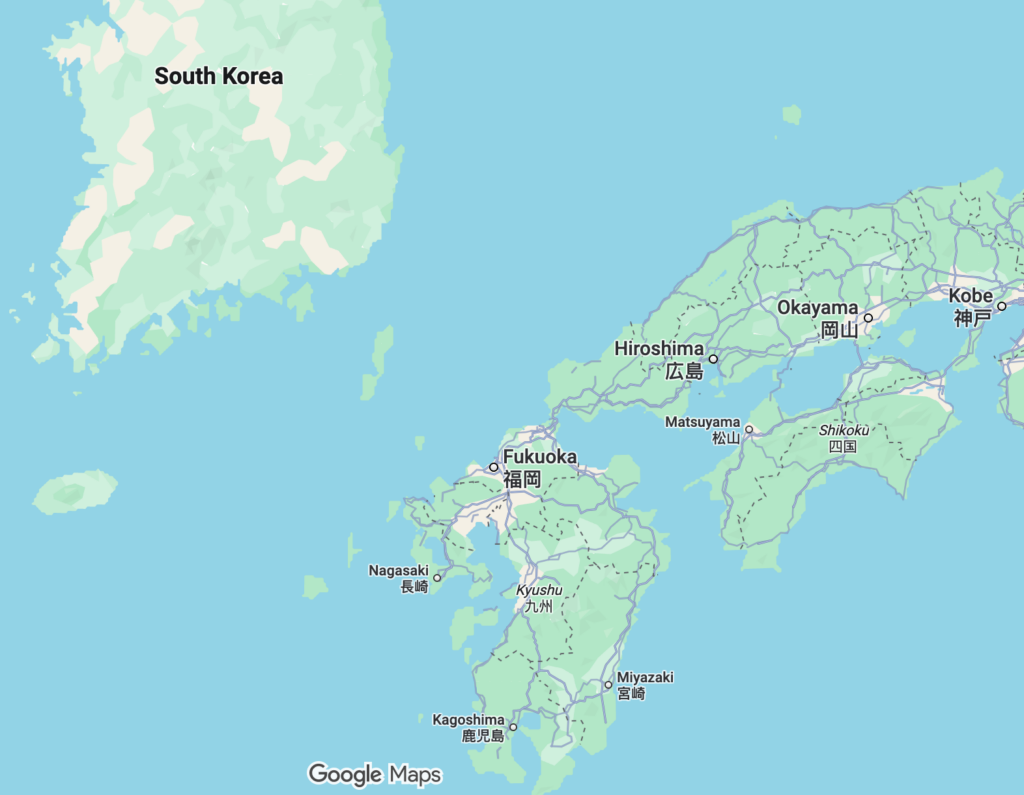
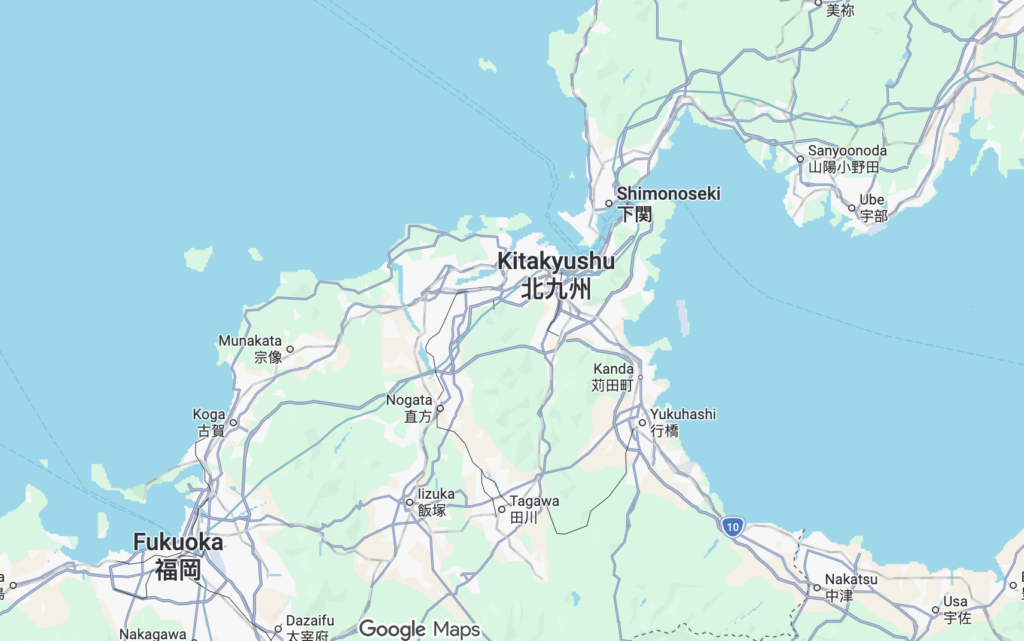
- The major powers had access to Japanese markets by 1859 despite the internal opposition (they all signed their own agreements after Kanagawa). The British victory over China in the Opium War of 1839 was a factor.
- It was important to the new Japanese government that they were seen as equals with the West. One of the strategies to achieve this was to adopt Western institutions – this would also help them achieve two key aims: to abolish the unequal treaties and to develop a stable political system.
Primary Source
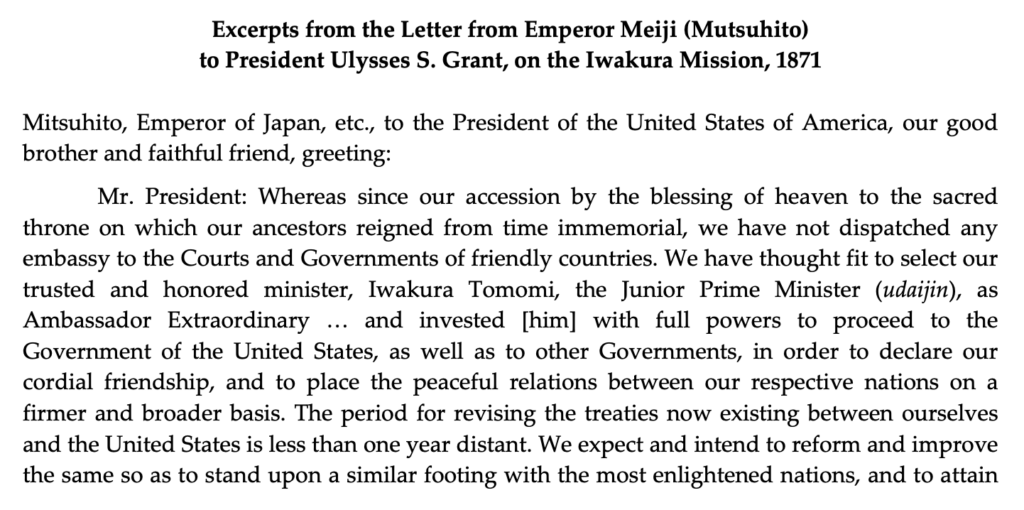
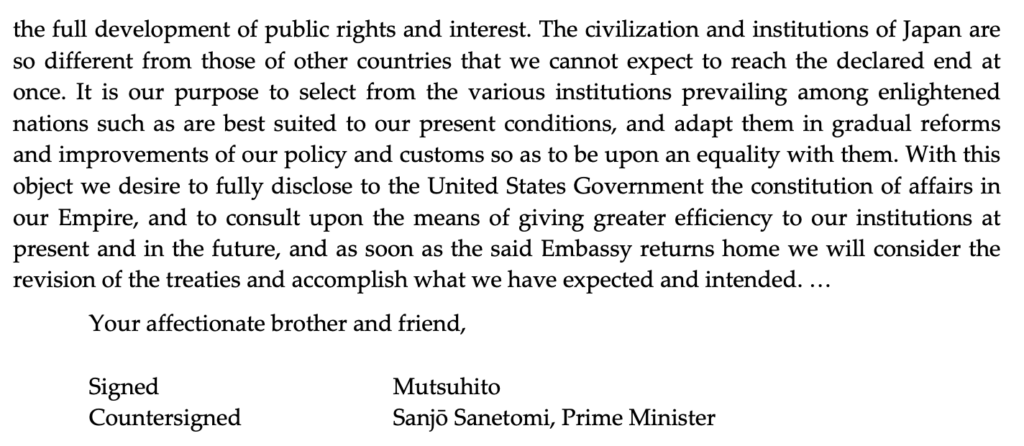
- As expressed in this letter, what are the Emperor Meiji’s aspirations for Japan’s future? How will these aspirations be attained?
- Why is the emperor being so friendly towards the US? Think of the context here, analyse the origins and purposes to do this.