
- A Unipolar World
- Ukraine-Russia & NATO
- Israel and the Middle East
- Iran and Saudi Arabia
- Korea
- Taiwan
- Nuclear Weapons
- China and the US
A Unipolar World
If you are choosing this topic, the research question could be something similar to:
‘To what extent is the United States being the only superpower good for the world?’

The Impact of the “Unipolar Moment” on US Foreign Policies in the Mid-East
- This is only a theory, some argue that the USA has not enjoyed a unipolar moment, there are always obstacles and other powerful countries which can limit their power. The article above explains that although it enjoyed immense power, it faced limits to it. Events such as 9/11 in 2002 and its failure to defeat the ‘insurrection’ in Iraq showed its weakness.
- Yet there is evidence to prove that the USA is dominant and we are still living in a unipolar world.
- Organisations such as the United Nations and NATO are dominated by the USA.
- The US dominates the world’s economy and financial institutions. Their currency is still the most powerful too.
- The US’ global political influence is unrivalled. China may have huge influence in Asia but not too much in the rest of the world.
- The US military is the most powerful in the world – see below.

Infographic: US military presence around the world
Ukraine-Russia & NATO
Possible RQ:
‘To what extent did the expansion of NATO lead to the Ukrainian/Russian War AND could the organisation find a solution to the conflict too?
- One of the arguments for why the war started between Russia and Ukraine is because of the expansion of NATO and the European Union. NATO stands for North Atlantic Treaty Organisation and was set up in 1949. Its purpose was to use military force to repel any Soviet aggression, famously using Article 5:
“The Parties agree that an armed attack against one or more of them in Europe or North America shall be considered an attack against them all and consequently they agree that, if such an armed attack occurs, each of them, in exercise of the right of individual or collective self-defense recognized by Article 51 of the Charter of the United Nations, will assist the Party or Parties so attacked by taking forthwith, individually and in concert with the other Parties, such action as it deems necessary, including the use of armed force, to restore and maintain the security of the North Atlantic area.”
- In 1949, the NATO membership was,

Belgium, Canada, Denmark, France, Iceland, Italy, Luxembourg, the Netherlands, Norway, Portugal, the United Kingdom, and the United States were the original members
- By 1991 membership had increased, largely because of the Cold War.

During the Cold War, Greece and Turkey joined in 1952, West Germany joined in 1955 (which became unified Germany in 1990), and Spain joined in 1982. So, by the end of 1991, NATO consisted of these 16 countries.
- Although the Soviet Union dissolved and the Cold War ended, NATO continued to grow.

1999: Poland, Hungary, Czech Republic
2004: Bulgaria, Estonia, Latvia, Lithuania, Romania, Slovakia, Slovenia
2009: Albania, Croatia
2017: Montenegro
2020: North Macedonia
2023: Finland (joined in April 2023)
- The Russia-Ukraine War began in 2022. The leader of Russia, Vladimir Putin, lists NATO expansion as one of the key reasons for war. You only have to see the different maps to see that NATO was moving closer to Russia’s border.
- In the 1990s there were talks about disbanding NATO or at least, limiting its growth. Watch the interview below and try to answer the following questions:
a. Why did US ‘realists’ not want to expand NATO? 0:35 – 01:28
b. But the liberals And President Clinton disagreed, what was their argument? 0:36 to 02:00
c. Why did the trouble start in 2008? 02:30 to 03:30
In 2014, Russia took Crimea from Ukraine and a war began in the east of the country. There was also a revolution in Ukraine, with a pro-EU and NATO prime minister (Petro Poroshenko) taking power.
d. What does Mersheimer say about the causes of this war? 04:40 to 05:30
- A possible Russian view against NATO expansion is that the invasions come from northern Europe. This is explained in the IBDP History section on the Soviet Psyche.
- For more information, read Russia and the Curse of Geography.
Israel and the Middle East
Possible RQ:
‘To what extent could the major states of the world solve the problems of the Middle East?’
- The Arab-Israeli conflict was a proxy battleground during the Cold War, with the US supporting Israel and the Soviet Union backing different Arab states. Arguably, these countries would have been rivals even without the Cold War but it could have made things worse.
- Cold War alliances influenced major wars like the Six-Day War (1967) and the Yom Kippur War (1973), shaping current geopolitical divides and security dynamics in the Middle East. The Soviet Union supported Egypt and Syria during the Six-Day War and the former during the latter war, the US supported Israel on both occasions.
- The Six-Day War remains controversial today because it led to Israel taking control of large parts of Jerusalem, the Sinai Desert and the Golan Heights. See below
- The Golan Heights (a mountain range) allows Israel to dominate the high ground, a strategic advantage over a possible rival.

Six Day War: Six ways the conflict still matters
- Today, Syria still wants the Golan Heights back.
- Egypt was given back the Sinai as part of the Camp David Accords in 1977-78 but there is still some tension between the two countries.
- Some of the left believe that Israel is a form of Western imperialism ( a settler-colonial project) and reject its existence. Israel is consistently criticised for its domestic and foreign policies, irrespective of what they are. They are seen as oppressors, invading the land which belongs to the indigenous Palestinians.
- However, on the right, many defend the country because it is seen as ‘the only democracy in the Middle East’ and has many cultural and historical links to the West. Moreover, as Jews (the majority in Israel) have been persecuted for most of history, defending them is a moral duty.
Iran and Saudi Arabia
This was written before the events of Saturday 28th February, 2026:
Possible RQ:
‘To what extent could the major states of the world reduce the Saudi-Iran rivalry?’
- During the Cold War, Saudi Arabia was supported by the US. Its huge oil reserves and dominance among the Sunni nations in the Middle East meant that the US could influence the region via Saudi.
- On the other hand, Iran after 1979 was a Shia-led theocracy and was influenced by the Soviet Union.
- The two nations, Saudi and Iran have been bitter rivals for decades. They have influence over the entire Middle East and North Africa.

Saudi Arabia’s Answer to the Iran Deal
- Even today, albeit much reduced, both the US and Russia have some influence over the same two nations.
Post 28/2/2026
- The relationship between Saudi Arabia and the US has been generally positive in recent times, the Abraham Accords in 2020 further strengthening them. Saudi see Iran as their major regional rival in the Middle East.
Korea
Possible RQ:
‘To what extent could the major states of the world find a permanent peace treaty on the Korean peninsular?’
- Between 1950 and 1953, South and North Korea were at war. The South had the help of the United Nations (although it was largely the US) and the North was helped by China and the Soviet Union. Although an armistice was signed in 1953, technically the two countries are still at war.
- There is still tension between the two countries and, on occasion, North Korea have fired missiles on the South. This is one example.
- North Korea have also fired missiles over Japan in recent years too.
- There is always the threat of the conflict escalating, especially as the US supports the South and China, the North. It could be used as a proxy war although the risk for this is currently low.
- Arguably, the North Korean leader behaves erratically too and this is a threat to the current ‘peace’.
Taiwan
- China had a civil war from 1927 to 1949. The Chinese Communist Party (CCP), led by Chairman Mao (on the right in the image below), was victorious against Chiang Kai-shek (on the left), who led the Guomindang (nationalist party).
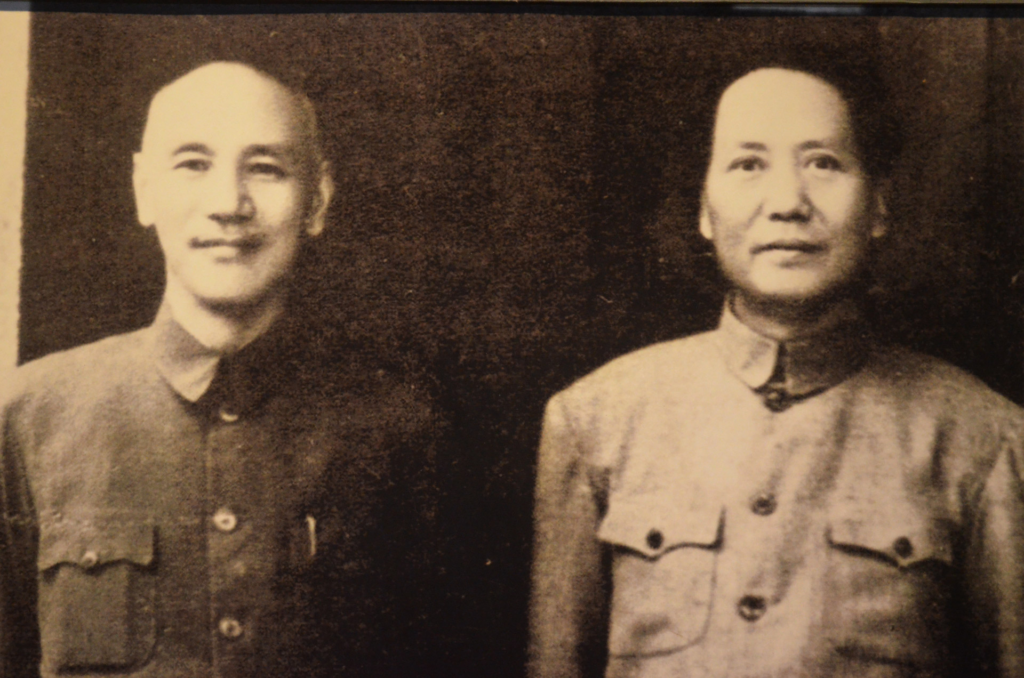
- In 1949, the Guomindang left mainland China for Taiwan. They set up the Republic of China whereas the mainland was called the People’s Republic of China (PRC).
- During the 1950’s, Chaiman Mao and the PRC twice attempted to bring Taiwan under the control of the Chinese government. There were two crises, 1954 and 1958, but neither were successful for Mao.
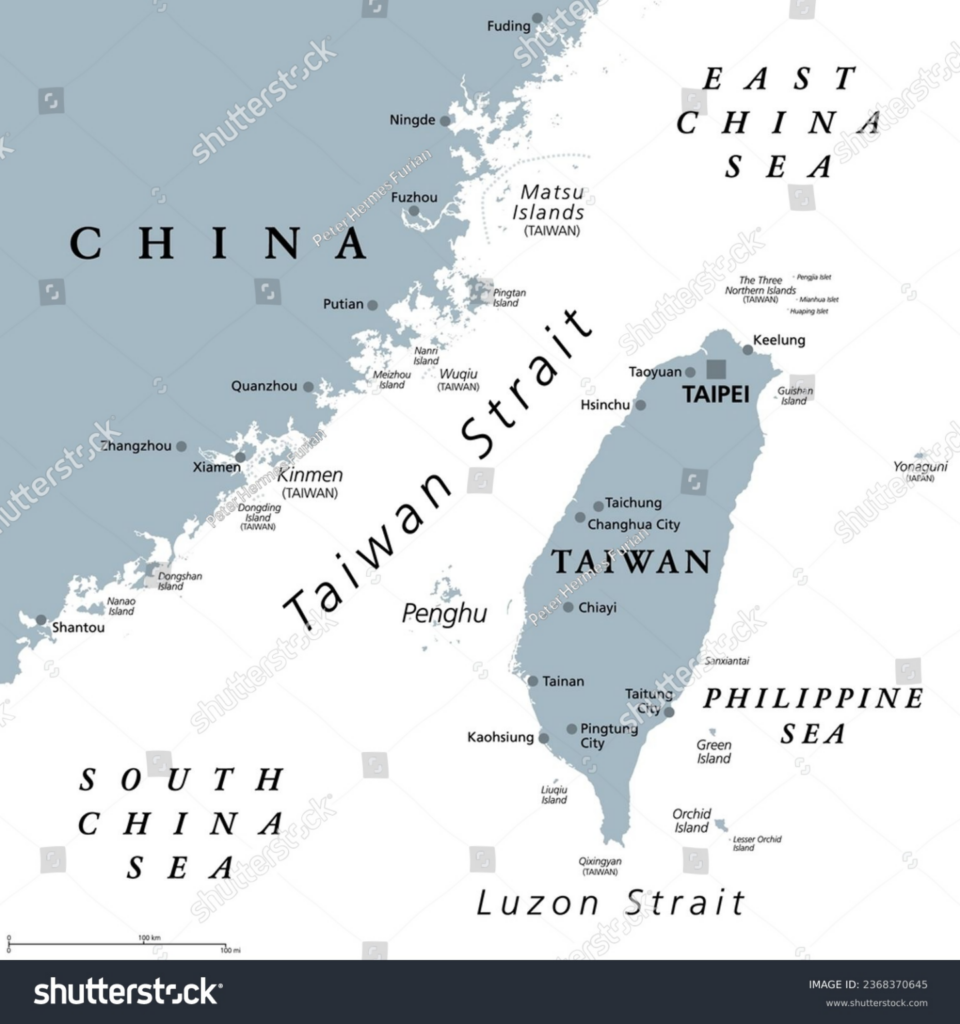
- As a result of the Cold War, the US took the side of Taiwan as it opposed the communist PRC. This is a simple explanation of the crises…
- Mao died in 1976 but China still wants the island to be part of their country. This is the One-China policy.
- In 1996 and 2023, China again showed the world that the policy remains important to the country.
- So a few questions for you if you choose Taiwan as your case study:
- Is taking Taiwan worth the risk? Also, is defending the island worth it too?
- As China and the US are the two most powerful nations and militaries in the world, would a conflict between them lead to a third world war?
- Does the economic relationship between the US and China make it less likely that a conflict would happen between them?
- As China has some elements of capitalism, the rivalry with the US is less ideological than it was with the Soviets. Does this mean war is less likely too?
Could China take advantage of US involvement in Iran?

‘Niall Ferguson: This Is How the Iran War Goes Global’, The Free Press, 17/3/206
Nuclear Weapons
Possible RQ:
‘To what extent could the major states of the world reduce the threat of both nuclear war and the number of nuclear weapons in the world?’
A key legacy from the Cold War is the threat from nuclear weapons. This may have dissipated (disappeared) since 1991 but the number of countries which have acquired them increased.
| Pre-1991 | Post-1991 |
| United States Soviet Union United Kingdom France China Israel (unofficially) | India Pakistan North Korea |

Countries with Most Nuclear Weapons in 2025
- 1962 and the Cuban Missile Crisis has been the closest the world has come to nuclear war. The ‘Doomsday Clock’ is a measurement of this possibility.
- The answer to the question is much more complex than simply arguing to get rid of nuclear weapons. This is not a realistic solution to the problem. None of the powers who have these weapons are likely to destroy them, doing so may only leave them weaker. But is there a system of reducing the number of nuclear weapons in the world?
- Those who have nuclear weapons rarely want other countries to possess them. Iran is a modern example of this. The US, UK, France, Saudi Arabia and Israel absolutely do not want Iran to develop nuclear weapons. Russia and China are more nuanced. They may not want a nuclear Iran but they do not mind too much as it would weaken their rivals.
BUT the peace dividend and nuclear deterrence…

What Happened to the Peace Dividend?
The Peace Dividend
- In 1991, the Soviet Union disintegrated and the Cold War was no more. For decades, the threat of a third world war or even nuclear war was real. With the fall of the Soviet Union, this threat was significantly reduced. This had a huge impact, one that is still present today, on the defence spending around the world.
- For an estimate on these differences, I asked Perplexity.ai to provide me with a table.

- The sources used have both their values and limitations but this helps give you a general idea of the differences.
- The reduced spending on defence (army, navy, air force, nuclear etc.) is called the peace dividend.
- Governments decided to spend these savings on other things, notably welfare and social systems.
- Some also cut taxes as they did not need as much money. This would prove very popular with voters in democracies.
China and the US
Essentially, some theorists argue that the rivalry between the two most powerful countries in the world is a new Cold War. The US has military bases all over the world, protecting its trade routes and expanding or maintaining its political and economic power. You can see this power below.

Infographic: US military presence around the world
in recent years, China has sought to do something similar, albeit with economic ‘bases’ rather than military.

Think about this: wherever there is a US military base in the world, it limits the influence China could have. Conversely, wherever there is a Chinese-influenced port in Africa, it limits US economic power too. Compare ‘Chinese’ ports to those influenced by the US…
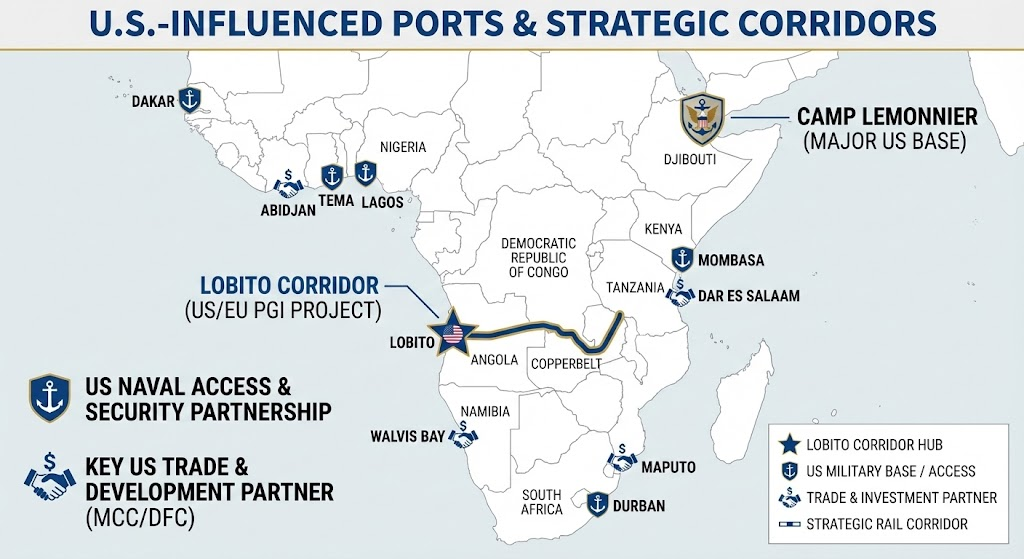
But why has there been such a push to acquire influence in Africa?
Watch from the start of the following video to …
Why has there been a growth in foreign powers influencing African ports?
How many ports does China now influence?
What is a key location in Africa and why?
What are dual ports?
Rare earths, a video some of you watched in the Energy unit, may also be a factor.