
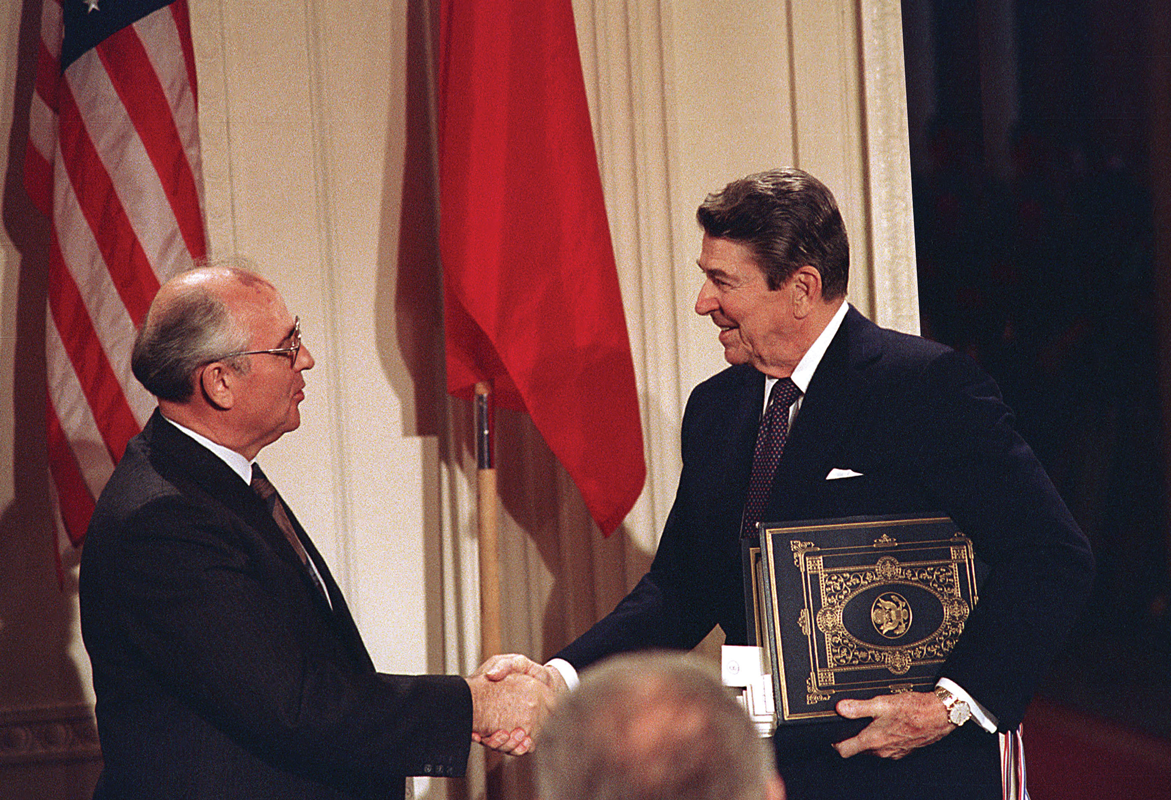
As with all historical events, there are different views on how the Cold War ended. This page tries to keep the level of detail relatively brief as you will not need a huge amount of depth to write an essay on the topic. To date, the following examination questions have been asked:
November 2024

May 2024

May 2023

November 2021

November 2020

May 2018

November 2017

The Arguments:
The first ‘three’ arguments reflect the ‘Great Man Theory’ of history – that individuals can change history rather than society.
1. President Reagan’s Arms Race, especially his Strategic Defense Initiative (SDI).
2. Human Rights, Helsinki and the role of President Carter. The US focus on developing human rights across the world influenced people and organisations behind the Iron Curtain.
3. President Nixon’s policies towards China, developing economic and political ties, ended the Cold War. He took advantage of the Sino-Soviet split and weakened the Communist influence across the world with his diplomatic moves (China may argue that Mao did this rather than the US). Moreover, with China as a rival rather than an ally, the Soviets would have to station troops along their borders, which could either weaken their security in Europe if they transferred resources from there, or weaken their economy if they had to invest more in their armed forces.
4. The US Fleet, nuclear submarines and their technological advantage.
5. The Soviet Economy was collapsing:

This could link to argument no. 1 as the Soviet Union was spending as high as 40% of their GDP on the military. The Soviet economy was generally weaker by 1 to 2 % each year for decades and this was compounded to create a huge gulf between the two.
6. General Secretary Gorbachev is often heralded in the West for ending the Cold War, he even won the Nobel Peace Prize in 1990. But there is an argument that he was partly responsible for the Soviet Union losing the Cold War:
- he wrongly assumed that organisations such as NATO and the European Union would end when the Warsaw Pact and Comecon ended.
- Gorbachev misunderstood Eastern Europe. He thought that he would get credit for reform and allowing these countries to become more independent. He did not expect them all to get rid of the ‘yoke’ of communism and turn to capitalism.
- allowing glasnost led to the Soviet Union disintegrating internally, there were independence revolts across the empire and not just in eastern Europe.
- Advisors such as Georgy A. Arbatov (a Soviet expert on the US) blames ‘The stupidity of the leaders’ for the Soviet demise and a Soviet ambassador to the US Vladimir P. Lukin said ‘Gorbachev was no Deng Xiaoping‘.
35.18