
- Ideologies and Strategic Interests
- 1946 – Capitalism V Communism,
- 1946 – Stalin’s ‘hostile’ speech – communism & capitalism were incompatible
- 1946 – The Iron Curtain Speech
- Taking over Eastern Europe
- 1947 – Truman Doctrine
- 1947 – Marshall Plan
- 1947 – Czechoslovakia
- 1949 – NATO
- Who was to Blame?
Ideologies and Strategic Interests
Watch the second part of the CNN series on the Cold War – Iron Curtain (1945-1947). From 08:13 to 13:40:
- What did the Red Army do to Berlin and how do you think this influenced the western perspective of the Soviets?
- What was the allied policy towards Germany?
- Discuss what the alternatives to this policy could have been?
Capitalism V Communism
- Are capitalism and communism compatible? Like most things in life, there is not a simple answer!
- There have been examples of a communist and capitalist countries working together (contemporary China for example). But there was a fear before and after the Second World War that this was not possible, and that one may not be able to exist with the other.
- The Soviet Union:
- Believed in Marxism, or at least the leader’s interpretation of it. This argued that the bourgeoisie (middle-class) exploited the proletariat (workers) in a capitalist country. To prevent this, all resources should be owned and controlled by the state. The rulers of this country would be the workers, who would deliver equity to the people.
- But in reality, Stalin ruled as a brutal dictator, using fear to make some of his policies successful. There were few human rights and the economy was not developed sufficiently to give the people the Marxist utopia they were promised.
- The USA:
- Believed in capitalism and democracy. A private individual could own land and property and make profit as a result. The competition between these individuals would continue to grow the economy. The government could be voted out of office if the people were not satisfied so there was an effective social contract. There was also freedom of speech.
- But in reality, workers, particularly in the 1930s, did not prosper and there was inequality in the economy. Moreover, some minorities were not allowed to vote, black and Asian people for example.
1. Who were the two main leaders representing opposing ideologies at the start of the Cold War? 0:07
2. What are the core beliefs of the United States’ ideology during the Cold War?0:07 – 1:37
3. What economic system did the United States support, and how does it function? 1:25 – 2:32
4. What were some criticisms of capitalism mentioned in the video?2:19 – 2:52
5. How did the Soviet Union’s economic system differ from the U.S., and how was it managed? 2:52 – 3:16
6. What were the strengths and weaknesses of the Soviet socialist economy? 3:00 – 3:36
7. How did political representation differ between the U.S. and the USSR? 3:30 – 4:35
8. What was the Soviet concept of democracy according to Marxist theory? 4:21 – 4:50
9. How did the two superpowers differ in their approaches to trade and economic self-sufficiency? 5:30 – 6:40
10. What contrasting views did the U.S. and USSR have about citizen rights and government responsibilities? 7:35 – 8:45
Stalin’s 1946 Speech
- This speech (some excerpts are below), by Josef Stalin, was given in February 1946. According to western perspectives at the time, and possibly even now, it was aggressive towards capitalism. However, the Soviets disagree, only stating that Stalin was explaining how inevitable conflict was between capitalist countries.


Watch the Iron Curtain (1945-1947) and answer the following question.
24:35 to 27:00 Was war inevitable between communism and capitalism?
1946 Iron Curtain Speech

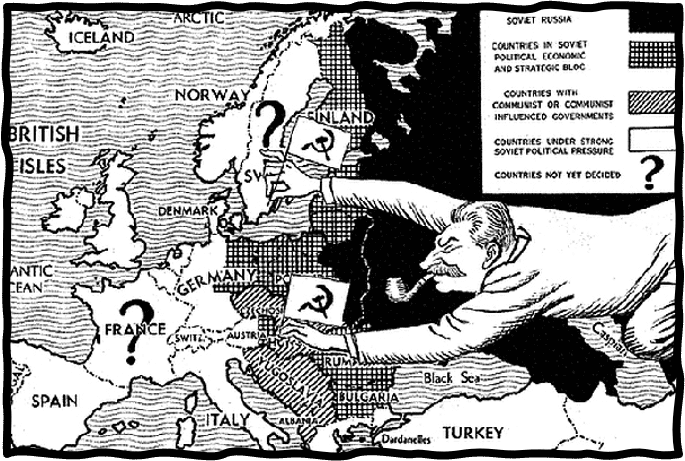
- The Red Army had advanced through eastern Europe as they pushed back the Germans during the Second World War.
- According to the Yalta agreements, the Soviets should help facilitate democracy in eastern Europe.
- But the Soviet Union began to support the communist parties within eastern Europe instead. Some people voted for them because of their relief that the Red Army removed the Nazi threat but the communist members and officials used force to help them achieve power too.
This source was produced in 1947. Do you think it is accurate?
Continue watching Iron Curtain (1945-1947) and answer the question:
07:30 to 19:05 How did the Communists spread their influence in eastern Europe?
But as the Soviet Union expanded its influence and possibly even its borders, some in the West grew fearful. Winston Churchill, the wartime prime minister of Britain, gave one of the famous speeches of the Cold War.
- The famous part of the speech is below…

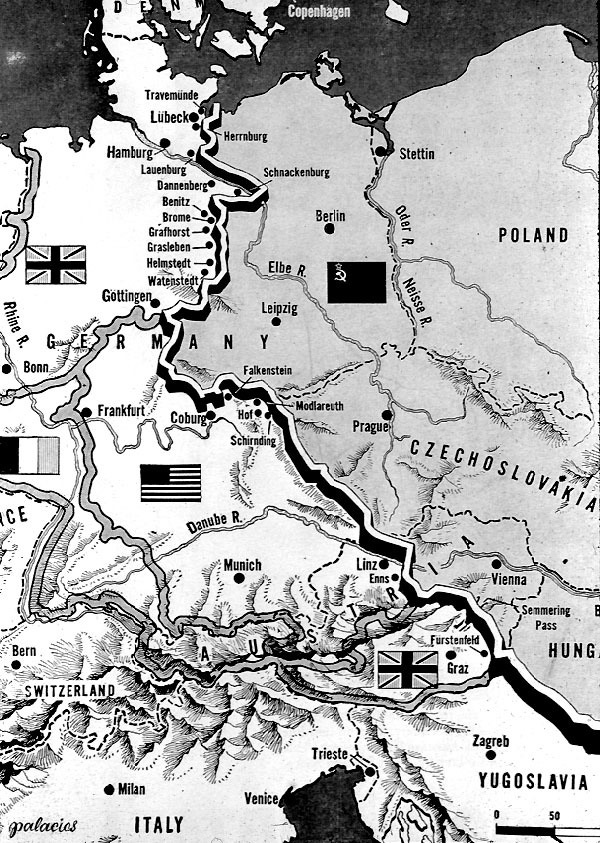
Q. Can you see some of the cities Churchill was talking about?
Q – what impact do you think the Iron Curtain speech had on the Soviet Union?
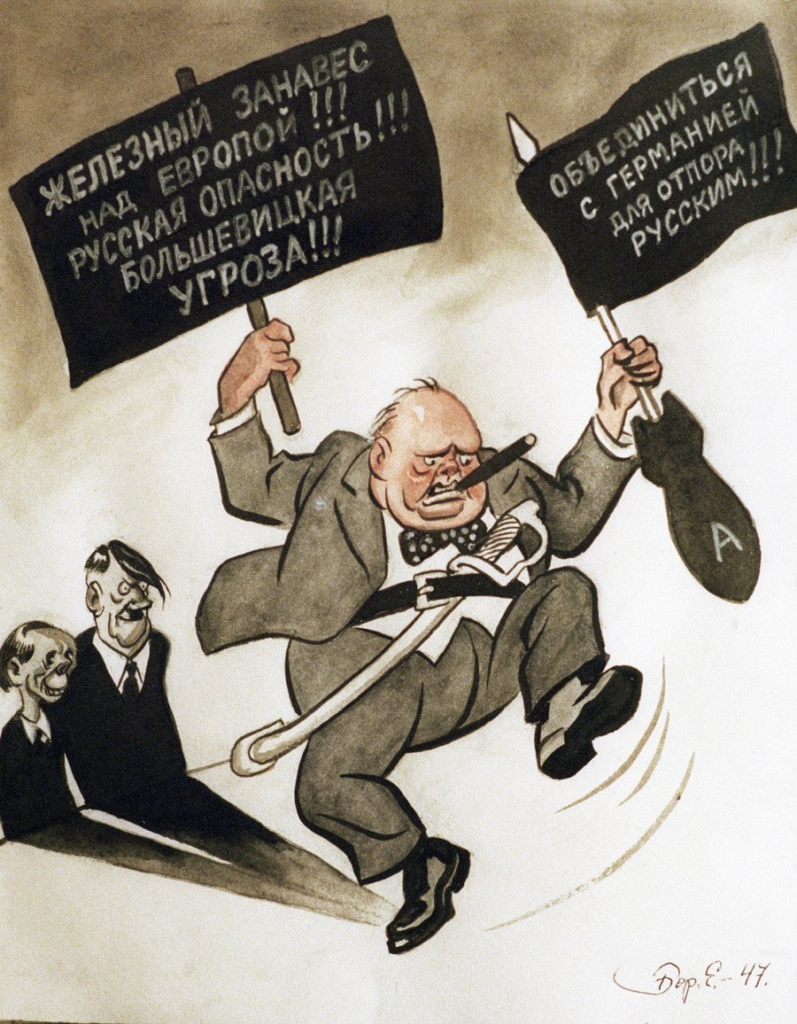
A 1946 Soviet cartoon showing Churchill jumping around carrying a placard and flag reading “Iron Curtain over Europe!!! Russian danger!!! Russian threat!!! Unite with Germany to combat the Russians!!!” Hitler and Goebbels look on approvingly.
Taking over Eastern Europe
Much of what is written here is from Mark Kramer’s Stalin, Soviet Policy, and the Consolidation of a Communist Bloc in Eastern Europe, 1944-53.
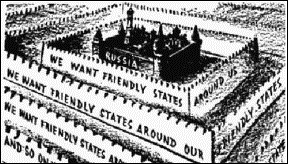
- There was no plan by 1946 for the Soviet Union to take over Eastern Europe but by 1948 it had achieved influence over most of the region.
- After the Second World War, Stalin enacted repressive policies in the Soviet Union to maintain his power. The perceived threats to his position made him expand these policies to Eastern Europe as well.
Pre-WWII
- The Russian Empire lost territory to Poland after the First World War, this made their western flank weaker than before the conflict. See the maps below from WW1: Does the peace that ended the war haunt us today?

- The West were suspicious of communist influence in Eastern Europe, the actions of Béla Kun in Hungary (a violent tyranny) during his Soviet republic reinforced this. However, countries such as Czechoslovakia, Serbia (part of Yugoslavia) and Bulgaria wanted a powerful Russia as they were a country to German expansionism.
- Yet as news of Stalin’s purges and the consequences of his collectivisation policies spread, countries such as Poland, Romania and Hungary became more likely to support Hitler rather than Stalin.
- …which became a problem for them all when the Nazi-Soviet Pact was signed!
- The British and French governments did not do anything about the Soviet atrocities in Poland in 1939, nor their invasion of Finland over the next six months.
- As a result of Soviet aggression, Romania, Hungary and Bulgaria opted to ally with Hitler’s Germany during the Second World War.
Post-WWII
Mark Kramer explains NINE consequences of the Second World War for Eastern Europe and the Soviet Union.
- ONE This paragraph reinforces the analysis in the rise of Stalin with the Soviet psyche. After the Second World War, he decided that no longer would the country be invaded from the West.

Page 59
- TWO To weaken his western flank, Stalin took the decision to take materials off Germany at the end of the war. This strengthened his own economic and military power and put the Soviets at an advantage.

Page 60
- If you read the last sentence, Stalin also wanted to spread the communist ideology. But he had to have sufficient military and political power to take over Eastern Europe soon. Stalin saw Béla Kun removed from power too easily so knew he needed strength in the region.
The key points from the video above:
a. Hungary was forced to give up huge territory to surrounding countries, this led to a revolution with the socialists and communists forming a coalition (though the latter were in charge under Béla Kun). He had support because people thought he may lead them to rescue the country from their enemies.
b. He began his rule with a land grab, taking it off the aristocracy, the Church and elite of the country. He then forcibly requisitioned food and this reduced his support.
c. Allied-supported Romania and later Czechoslovakia, Serbia and France attacked Hungary and were successful, ending communist rule in the country. Béla Kun’s government only lasted four months.
- THREE The Eastern European powers were weak after the Second Word War, this gave Stalin the opportunity to expand Soviet influence.
- FOUR During the Second World War, Britain and the US gave the impression to the Soviets that they would not prevent them from extending their sphere of influence over Eastern Europe. Decisions taken made at conferences such as Teheran (where military operations in Europe were split with eastern and western zones – the Soviets obviously to take the former) reinforced this.
- Furthermore,

Page 64
- The US also allowed the Red Army to take the glory in 1945 when taking Berlin, they even held back their own troops so that the Soviets could act. Mark Kramer argues that Washington may not have realised the political significance of this action at the time.
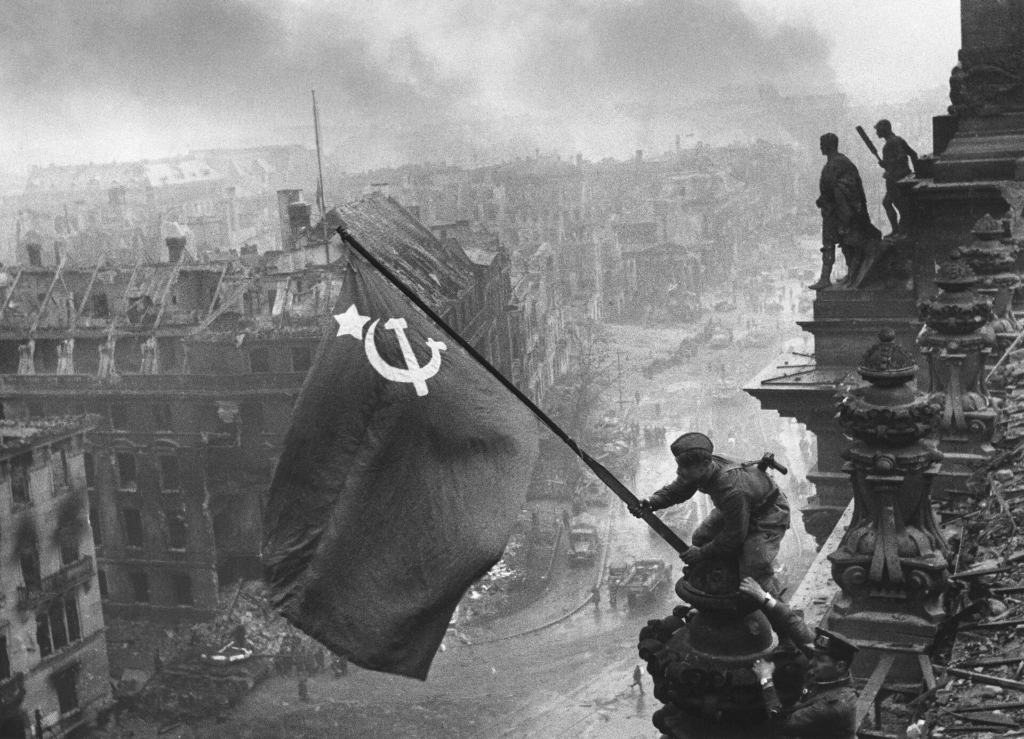
- FIVE As a result of the Red Army liberating Eastern Europe from the Wehrmacht, the local populations were initially favourable to the Soviets. They looked to Moscow for protection.
- SIX Conversely, some countries such as Poland, Hungary, and eastern parts of Germany, saw the harsh Soviet rule during the war and clearly did not want a continuation after 1945. So force may be needed…

Page 68
- SEVEN There was a lack of support in countries in Eastern Europe for communism. Even in Czechoslovakia, a country that was grateful to the Soviets for defeating Nazism and one that was hostile to the West for its ‘betrayal’ at Munich in 1938, the communists only received a peak of 38% of the vote in the 1946 elections. This only reinforced the need for Kramer’s SIXTH point, that force would be needed.
- EIGHT Geographically, the Soviet Union or Russia, would face a future western invasion from countries such as Poland and possibly Czechoslovakia. See below:


- Stalin believed he must counter this threat by ensuring areas such as eastern parts of Germany, all of Poland and the northern parts of Czechoslovakia are kept under Soviet control.
- NINE The Soviet Union was able to set the political agenda for Eastern Europe after the Second World War. With few exceptions, they also kept the region reasonably stable.
Stalin’s Policies for Eastern Europe
- Clearly Stalin wanted a military buffer within Eastern Europe but not necessarily a communist one too. However, he eventually feared western influence in the region so eventually decided to press local leaders to intensify the class struggle.
- An example of this was ‘allowing’ free elections in Hungary but, as a result of the communists losing, opted to intervene in other countries (Poland and Romania) so that this would not be repeated. Secondly, Stalin prohibited the East European countries to accept aid via the Marshall Plan too.
- Thirdly, there was a danger that Eastern European populations had been exposed to Western ‘alien ideas’ and their superior living standards. Stalin therefore destroyed any nationalist groups within Eastern Europe (those which had fought for liberation against Nazi Germany) largely through mass deportation and force.
- The latter was not entirely successful initially. The nationalist militia had grown strong towards the end of the Second World War so would not lie down in the face of Soviet aggression. Stalin needed the communist parties in each of the Eastern European nations to help destroy the nationalists. Therefore, the strategy became one of joint operations, especially in Czechoslovakia, Poland, Romania and East Germany. See below:

Page 76
- By the mid-1950s, all nationalist resistance had gone!
- Hungarian Communist party leader Mátyás Rákosi called the Soviet takeover of Eastern Europe as salami tactics. This was a gradual move to socialism, taking incremental steps to weaken the country’s democratic institutions (parliament). The aim was to isolate one’s enemies and then prepare the struggle against the reactionaries.
- In 1947, the Communist Information Bureau (Cominform) was established. It is generally seen as a response to the Marshall Plan although recent evidence, according to Kramer, dispute this…the plans for Cominform preceded the Marshall Plan.
- The final step in establishing Communist regimes in Eastern Europe was the takeover of Czechoslovakia in 1948. From this moment on, ‘People’s Democracies‘ worked with the Soviet Union to govern.
- However, not everything was a success. The Soviet Union gave up on trying to rule Greece and Finland.
Yugoslavia and Albania
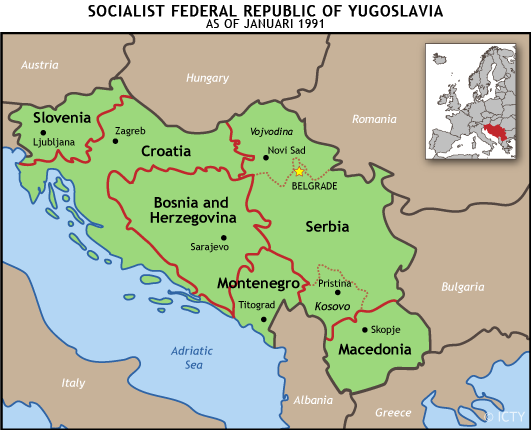
- The leaders of these countries, Tito and Hoxha respectively, fought against Nazi Germany and later installed governments which were based on the Soviet system.
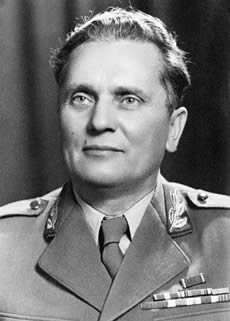
- Yugoslavia was one the biggest allies of the Soviet Union after the Second World War. But in 1948, at the Cominform summit, they were expelled from the organisation and publicly denounced.
- Tito wanted influence in the Balkans (especially over Bulgaria and Albania) and took action to achieve this without consulting Stalin and Moscow.
- This split demonstrated the weakness of the Soviet Union. Stalin tried to impose his will via economic sanctions but this only made Tito turn to the West and began to liquidate any pro-Moscow supporters.
- Stalin responded by condemning Tito as a fascist and even tried to assassinate him. However, he did not pursue any military activity as the geography of Yugoslavia was too difficult and the quality of the Warsaw Pact country’s armies were poor. Only the Red Army was strong enough to fight but Stalin really needed the resources of others to overcome Yugoslavia.
Arms Build-up: What could have happened to Yugoslavia?
- As explained earlier, the Warsaw Pact armies were in a poor condition in the late 1940s. Stalin sought to rectify this in the early 1950s. He wanted 1.2 million soldiers ready to go to war at a moment’s notice, and another 1.85 to 2 million reserves to be ready to be mobilised.
- Stalin saw the weakness of the US in the Korean War so saw an opportunity to build up East European forces.
- During the final two years of Stalin’s life, the size of the Soviet forces doubled, there were 5.3 million troops in March 1953. Reserves amounted to close to 10 million.
- Conversely, the Yugoslav armed forces by 1952 were weak. After all, there was no new weaponry from the Soviet Union!
- Classified documents from the US at the time indicated that Yugoslavia was ready for invasion. Forces from the Soviet Union, Hungary, Romania, Albania and Bulgaria were part of the plan to do so.
- …yet Stalin died before the full reorganisation of the Eastern European armies was completed. But it is impossible to say what would have happened had he lived longer, Stalin had yet to make up his mind to invade, only making preparations.
- He was clearly anxious about Tito’s rebellion, or Titoism, spreading to other East European nations. He took action by instructing local communist officials to purge other communists who were thought to have any ideas of autonomy.
Read Soviet Satellite States and summarise how each eastern European country became part communist.
1947 Truman Doctrine
- Although this began in 1947, arguably it was partly in place in 1945. When Stalin tried to extend the Soviet sphere of influence into Iran and Turkey in 1946, the West stopped him by threatening to go to war. Stalin backed down on both occasions. The West believed that they would not repeat the ‘mistake’ of Munich and that a show of force was necessary was needed to deal with all dictators.
- The Truman Doctrine was essentially to contain the Soviet Union and communism.
- The Truman Doctrine was heavily influenced by George Kennan’s Long Telegram. Watch the following short video and think about how Truman adopted the ideas of Kennan.
Continue watching Iron Curtain (1945-1947)
27:01 to 29:20 Why did Kennan write 8000 words!?
- It is easy to blame Truman’s government for escalating the tension between the two superpowers but Stalin’s was the same. Both had moderates and hawks but the latter won the arguments. For example, Truman had Clark Clifford and Stalin had Molotov, both encouraged hard lines to be taken against their rivals.
- Some key extracts (explaining some of the Soviet beliefs) from the Long Telegram are here:


- Truman took the decision to contain Stalin and Soviet Union because of several factors:
- Kennan’s Long Telegram
- Soviet actions in both Iran and Turkey – they had tried to expand their influence there, breaking previous agreements in the process.
- Soviet influence in eastern Europe was growing, and some of their actions were reminiscent of the Nazis in how they increased it.
- Churchill’s speech and the advice of some of the his own advisors (Clifford).
- Watch 32:00 to 37:20 in Iron Curtain (1945-1947) AND 40:50 to the end. What other reason (s) could you add?
1947 Marshall Plan
- In September 1945, Truman took the decision to end Lend-Lease. This did benefit the US economy but it also gave vital help to her allies during the Second World War. MOVE TOWARDS POST-WAR RECOVERY…
- However, Stalin thought this was a move to extract more concessions from the Soviet Union in return for any future economic help.
1947 Czechoslovakia
- It was decided at Yalta that Soviet armies should occupy the capital city of Prague.
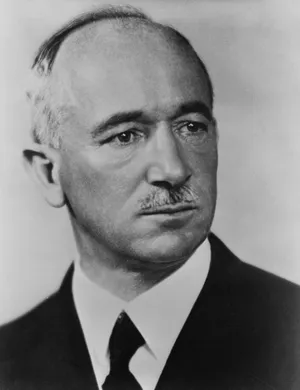
There were two governments in exile during the war: one headed by Beneš, who had been president of the country when it was taken over by Hitler in 1938.
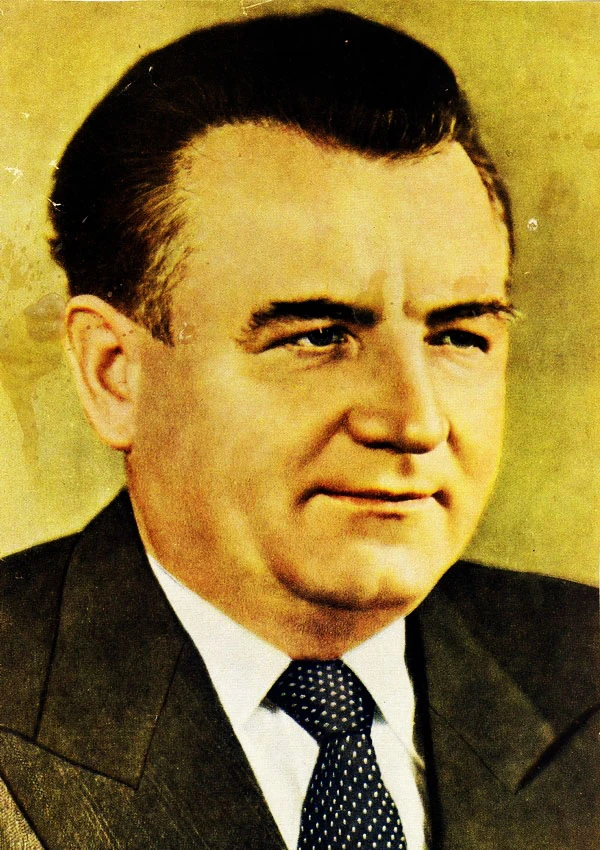
and Gottwald, who was supportive of communism. In 1945, they agreed to lead a new government (called the Košice government as this was the place where the two leaders met to discuss it).
when the war ended, with the former the president and the latter the deputy prime minister.
- The Communist supporters used their position in the Ministries of Interior Affairs and Defence to place Communist loyalists into key positions in the police and army.
- They also took over the press and used their influence to arrest and detain any anti-Communists.
- Importantly, in 1947 the country was invited to take part in the Marshall Plan. Gottwald, now prime minister, was to meet and discuss this but Stalin ordered him to Moscow instead. He was told to reject the Plan and join Cominform instead. To be fair, there was popular support not to join the Marshall Plan because of the hostility to the West – they were seen to have abandoned the country in 1938!
- Beneš was pressured to resign in 1948 because of pressure from the Communists.
For more detail, read JohnDClare’s excellent website – The Communists take power in Czechoslovakia – and after
1949 NATO
Who to Blame?
Padlet: The West was to blame for the Cold War because…
Padlet: The Soviet Union was to blame for the Cold War because…